



Short answer
Sauh.ee sells two 18V cordless snow shovels that also run on Makita batteries: the cordless snow shovel 33 cm (160 €, with 2 batteries and a charger 190 €) and the cordless snow shovel 30 cm (140 €, with 2 batteries and a charger 170 €). We put them side by side, photographed them and filmed them running.
Tooted selles juhendis
 Akulumelabidas 33 cmalates 160 €Vaata →
 Akulumelabidas 30 cmalates 140 €Vaata →
 Makita analoog aku 9ahalates 60 €Vaata →
The 33 cm is bigger, has wheels and sounds stronger: 3500 W, 32 cm clearing width, takes up to 18 cm of snow and throws it up to 7.8 m. The 30 cm is smaller: 3000 W, 30 cm width, up to 15 cm of snow, throws up to 6 m and folds down to 33 × 46 cm.
For a driveway, the area around the car and a longer path, take the 33 cm. For steps, a terrace, a balcony and little storage space, take the 30 cm. Neither is right for a large yard or deep wet snow. For that you need a mains-powered or petrol snow blower.
Video: hear which one is stronger
In the video we switch both shovels on and compare the sound. There is no snow in the video, but the difference is clear at once: the 33 cm motor is noticeably louder and stronger. That matches the numbers: 3500 W and 25,000 rpm against 3000 W and 20,000 rpm for the 30 cm. A higher speed means the auger throws snow further and copes with a deeper layer.
Side by side: what the photos show
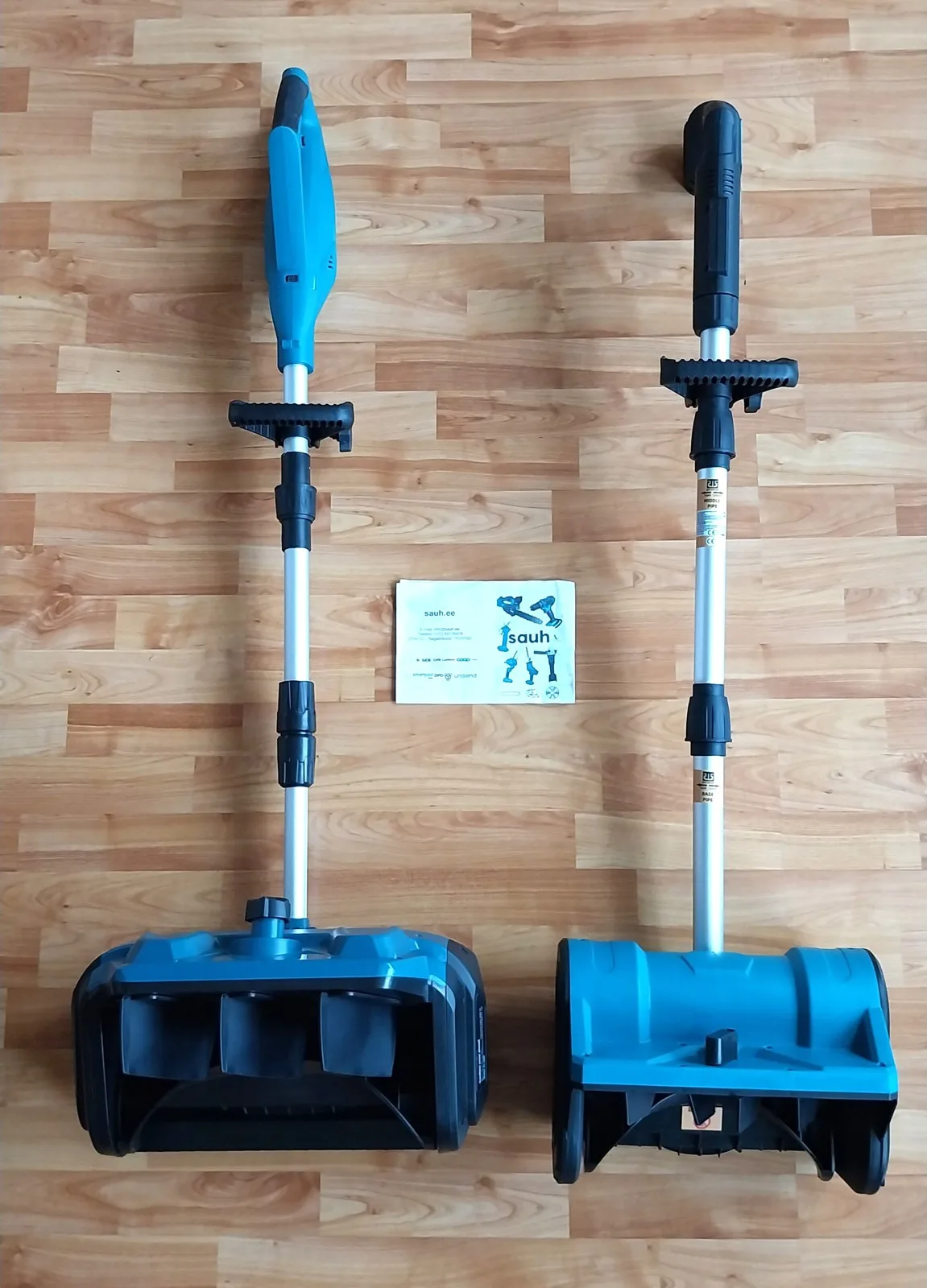
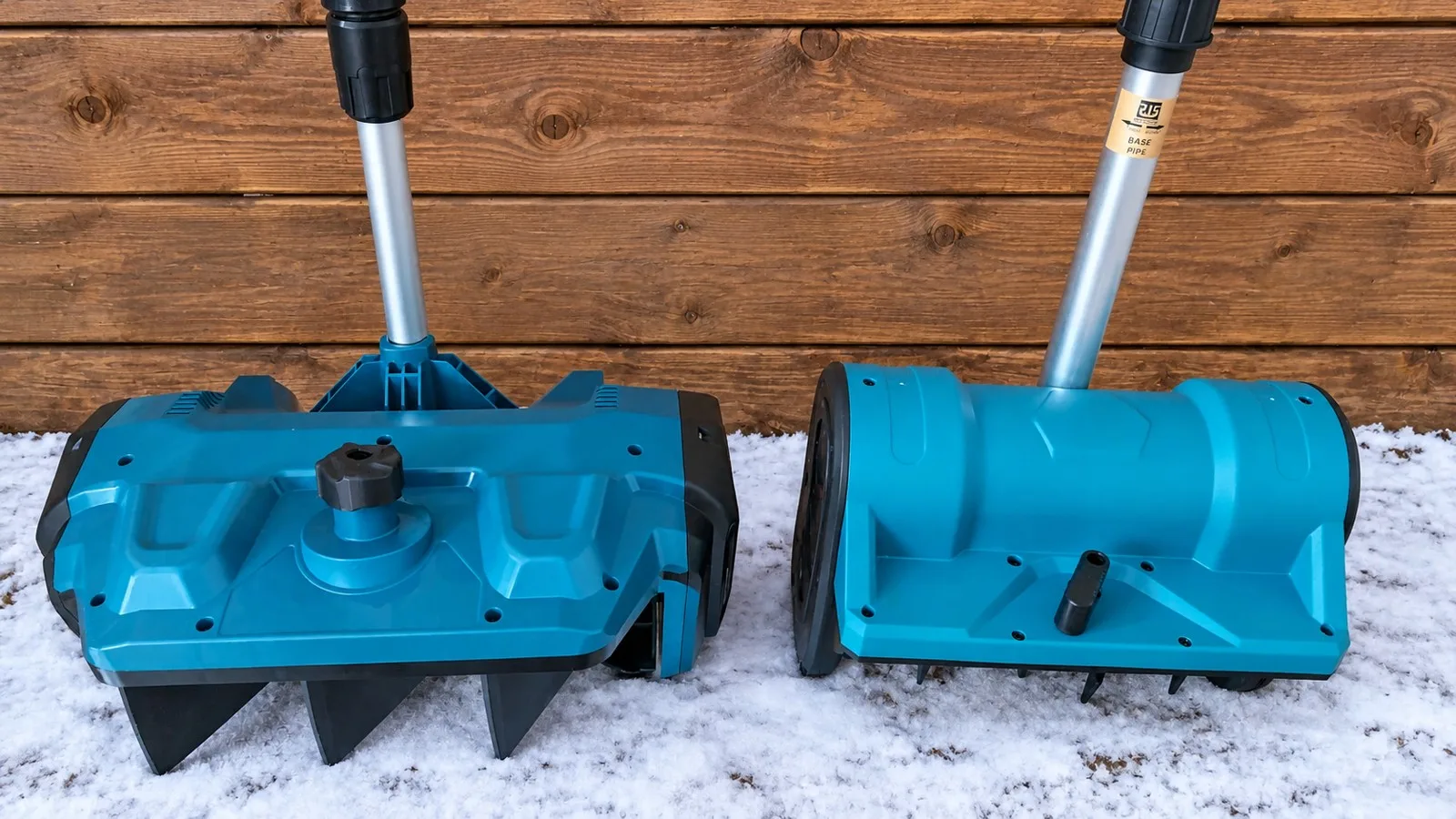
The 33 cm is on the left, the 30 cm on the right. The first thing you notice is the housing. The 33 cm housing is wider, taller and deeper; the 30 cm has a compact rounded housing. Both have an extendable aluminium shaft and a second handle on the shaft that you hold with your other hand to guide the shovel.
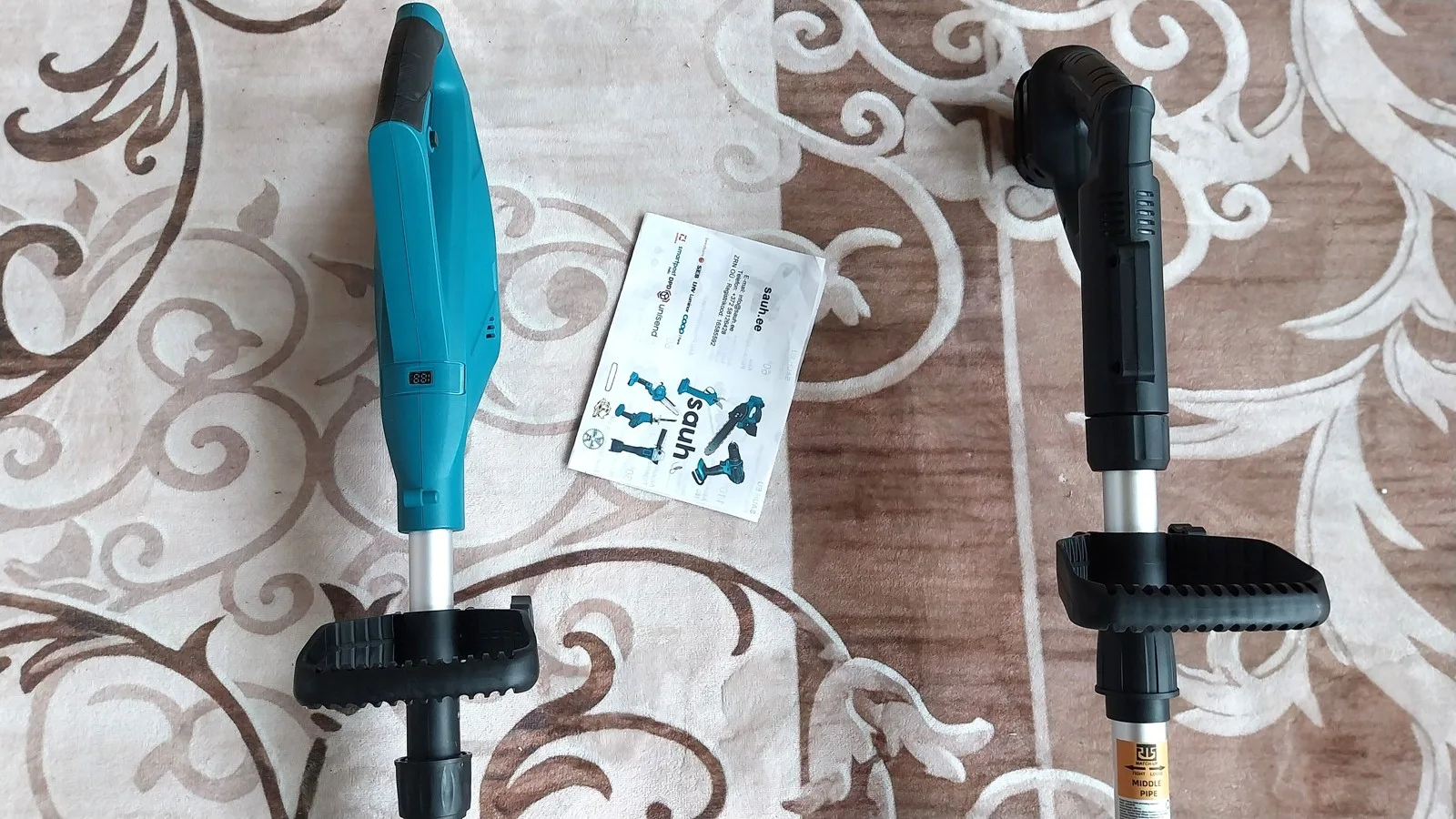
The 33 cm has a digital battery indicator on the handle, so you can see how much charge is left and the battery does not die halfway down the driveway. The 30 cm has no indicator.
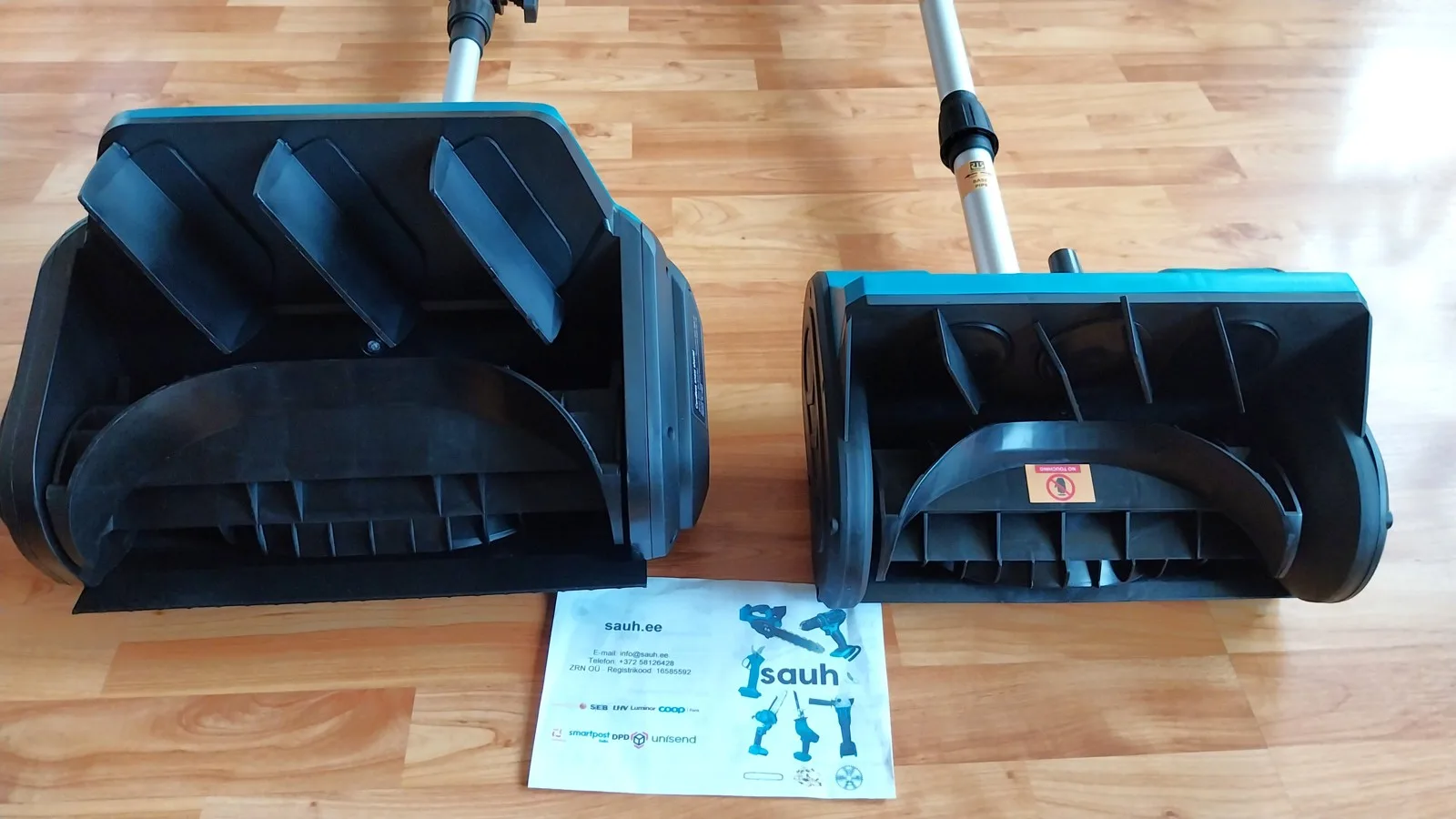
From below the difference is even clearer. The 33 cm intake is wider and taller, and the front edge has a rubber strip that slides along the ground. The 30 cm intake is lower. That is also why it takes less snow: 15 cm, not 18 cm.
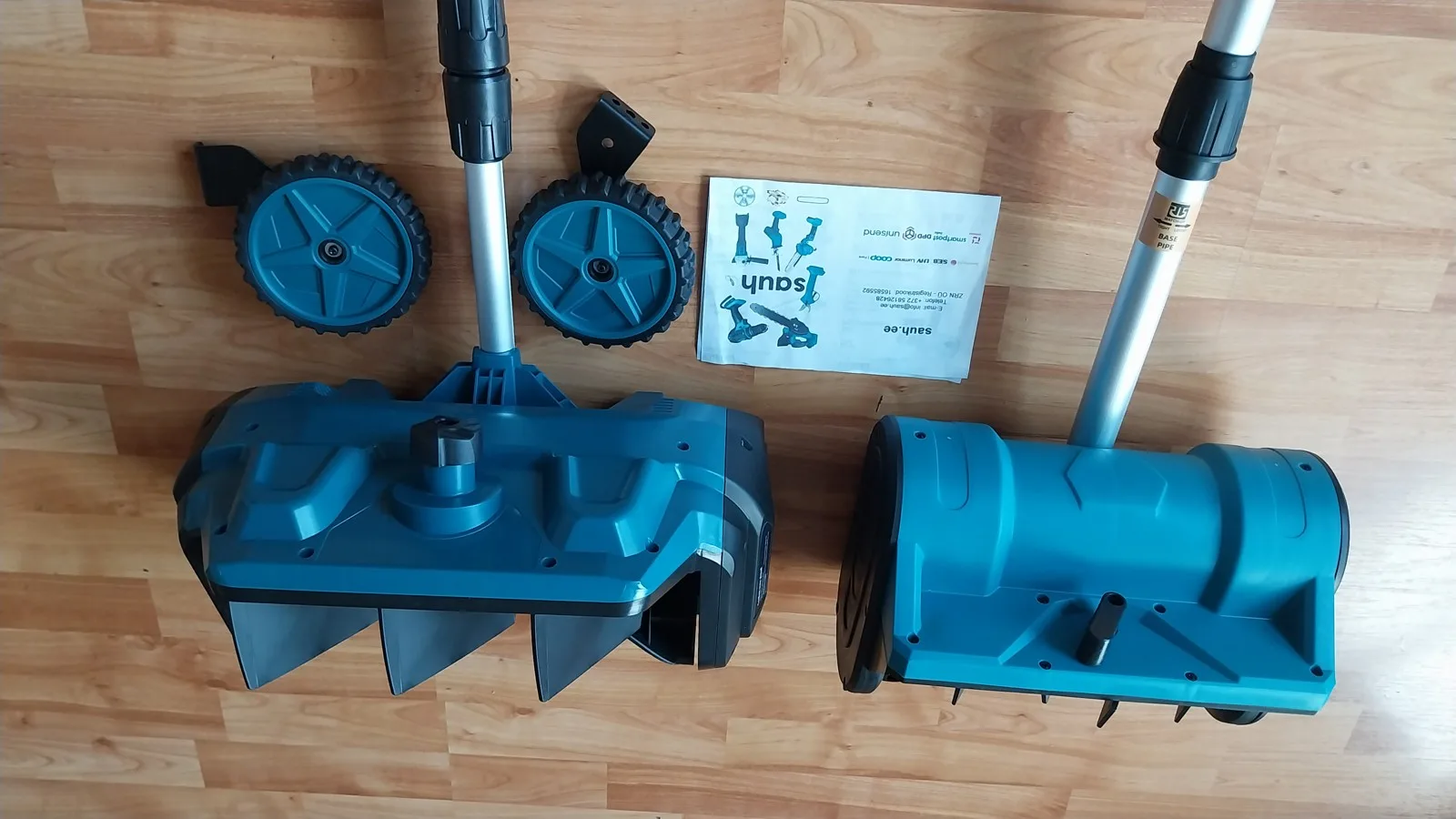
The 33 cm has two wheels that attach to the housing with brackets. The wheels carry the weight, so you push instead of carry. On a long driveway that is easier on the arms. The 30 cm has no wheels; it is smaller and easier to take along. Neither product page gives the weight.
Comparison table
| Cordless snow shovel 30 cm | Cordless snow shovel 33 cm | |
|---|---|---|
| Price, tool only | 140 € | 160 € |
| Price, + 2 batteries and charger | 170 € | 190 € |
| Motor | brushless, 3000 W | brushless, 3500 W |
| Speed | 20,000 rpm | 25,000 rpm |
| Clearing width | 30 cm | 32 cm |
| Snow depth | up to 15 cm | up to 18 cm |
| Throw distance | up to 6 m | up to 7.8 m |
| Throw direction | adjustable within 60° | 30° left / 30° right |
| Shaft | extendable and folding, 117 cm | telescopic 105–125 cm |
| Folded | 33 × 46 cm | 66 cm long |
| Wheels | no | yes |
| Battery indicator | no | yes |
| Sound in our video | quieter | louder and stronger |
| Battery | 18V, fits Makita | 18V, fits Makita |
The data comes from the product pages. The 33 cm model has 33 cm in its name, but its spec table gives a 32 cm clearing width. The table uses that number.
What the numbers mean in practice
Width 32 cm or 30 cm. 2 cm sounds small, and it is small. On a 5 m wide driveway the 33 cm makes 16 passes and the 30 cm makes 17. The main difference is not width but snow depth and throw.
Snow depth 18 cm or 15 cm. This is the most important difference. If 15–18 cm fell overnight, the 33 cm takes it in one pass. With the 30 cm you clear the same spot in two layers.
Throw 7.8 m or 6 m. When there is already a snowbank along the driveway, every metre counts. The snow has to fly over the bank, not land on it and slide back.
Power and speed. 3500 W and 25,000 rpm or 3000 W and 20,000 rpm. More speed means a faster auger, a longer throw and fewer clogs. You can hear it in the video too.
Which one to choose
Choose the 33 cm (160 €) if:
✅ you clear a driveway, a parking spot or the area around the car;
✅ 15–18 cm of snow falls at a time;
✅ there is a snowbank along the path and the snow has to go far;
✅ you want to see the battery charge;
✅ you would rather push on wheels than carry.
Choose the 30 cm (140 €) if:
✅ you mostly clear steps, a terrace, a balcony or a pavement;
✅ you have little storage space (folded 33 × 46 cm);
✅ you take the shovel to a summer house or keep it in the car boot;
✅ it snows often but not much, and you clear after every snowfall.
The price difference is 20 €. If in doubt, take the 33 cm. In winter, depth and throw are usually what you run short of.
Which battery to use and how long it lasts
Both shovels run on 18V batteries, including original Makita LXT batteries and our compatible ones. The “+ 2 batteries and charger” option includes two batteries and a charger; the product page does not state their capacity. For longer work we recommend a high-capacity battery: the 9 Ah battery costs 60 € (2 for 110 €), the 6 Ah battery 50 € (2 for 90 €).
The manufacturer does not state a run time. Owners of similar 18V snow shovels usually report 20–40 minutes per battery, less with wet snow. The more powerful 33 cm draws more current. If your driveway is long, keep a second battery warm and ready indoors.
A cold battery gives less power. Keep it indoors, put it in the shovel just before you start and charge it at room temperature.
How to use it
- Charge the battery indoors.
- Set the shaft length to your height so your back stays straight.
- Point the throw downwind and away from windows, the car and the road.
- Hold the main handle with one hand and the shaft handle with the other. Push the shovel forward steadily.
- Make passes side by side, each overlapping the previous one by a few centimetres.
- If there is more snow than the shovel takes, clear it in two layers: the top half first, then the rest.
- After work, remove the battery, shake the snow out of the housing and take the battery inside.
Wet snow, ice, gravel and wind
Wet snow. Heavy wet snow is the hardest job for a cordless shovel. Move slowly and take narrower passes. If the intake clogs, remove the battery and clear it with a stick. Never put your hand in the intake; the 30 cm even has a warning sticker for it.
Plough ridge. Packed snow pushed to the roadside by a plough is too hard. Break it up with an ordinary shovel first.
Ice. The shovel does not break ice. Use an ice scraper and sand or salt.
Gravel. On loose gravel the auger throws stones. Use it only if the gravel is frozen and covered with packed snow. Asphalt, paving stones, concrete and wooden decking are best.
Wind. Snow thrown into the wind comes back at you. Point the throw downwind.
Who they are not for
❌ A large yard, a farm or a long private road. The battery runs out before the job is done. You need a mains-powered or petrol snow blower.
❌ More than 18 cm of snow at once, if you don’t want to clear in two layers.
❌ Ice and hard crust.
❌ No 18V batteries and no wish to buy them. Then a mains snow blower is simpler.
Care and storage
After each use, shake the snow out of the housing and let the shovel dry at room temperature before you put it away. Check that the intake is clear and the screws are tight. Keep the battery indoors. In spring, store the battery about half charged. The 30 cm shaft folds and the shovel fits into 33 × 46 cm. The 33 cm is 66 cm long when folded.
Makita snow thrower – do you need the original?
Makita does not make a separate cordless snow shovel. It makes the SN400MP snow thrower attachment (30 cm width), which only works with a multi-function power head (DUX60, DUX18 or UX01G). Prices in Estonia at Tööriistamaailm (October 2026): SN400MP attachment 256.93 € and DUX60Z power head without battery and charger 316.45 €, 573.38 € in total without batteries.
To be fair: according to Makita, its solution takes deeper snow, up to 30 cm. For a normal house driveway and path, the cordless snow shovel 33 cm (160 €) does the same job for a fraction of the price and runs on the same Makita 18V batteries.
How to order
Both products have two options. “Tool only”: no battery and no charger. “+ 2 batteries and charger”: two batteries and a charger included. The 30 cm costs 140 € or 170 €, the 33 cm 160 € or 190 €. If you already have Makita 18V batteries, take the tool only. The delivery time is shown on the product page.
See the products:
🛒 Cordless snow shovel 33 cm – 160 € 🛒 Cordless snow shovel 30 cm – 140 € 🛒 9 Ah battery – 60 €
Frequently asked questions
Which one is more powerful?
33 cm: 3500 W and 25,000 rpm. 30 cm: 3000 W and 20,000 rpm. You can hear the difference in our video: the 33 cm is louder and stronger.
Why does the 33 cm model clear 32 cm?
The product name says 33 cm, but the spec table gives a 32 cm clearing width. We use the spec table number here.
How deep a snow do they take?
The 30 cm up to 15 cm, the 33 cm up to 18 cm in one pass. Clear deeper snow in two layers.
How far does the snow fly?
33 cm up to 7.8 m, 30 cm up to 6 m. Both have an adjustable throw direction: the 33 cm 30° left and right, the 30 cm within 60°.
How long does one battery last?
The manufacturer does not say. For similar 18V shovels people usually report 20–40 minutes, less with wet snow. For longer work use a 6 Ah or 9 Ah battery and keep a second one warm.
Do Makita batteries fit?
Yes. Both run on Makita 18V LXT batteries and on our compatible 18V batteries.
Are a battery and charger included?
Only if you choose “+ 2 batteries and charger” (30 cm 170 €, 33 cm 190 €). The “tool only” option comes without battery and charger.
Does it handle wet snow?
Yes, but slower and with a shorter throw than dry snow. Move slowly and take narrow passes. For very wet heavy snow the 33 cm is better because it has more power.
Which is better for steps?
The 30 cm. It is smaller, has no wheels and is easier to hold on a step. The 33 cm is bigger and has wheels. That helps on a flat path but is awkward on stairs.
Can I use it on a gravel drive?
Only if the gravel is frozen and covered with packed snow. On loose gravel the auger throws stones.
Why does the snow blow back at me?
Usually because of the wind. Point the throw downwind and away from yourself.
Does the shovel break ice?
No. It is made for loose fresh snow. For ice use an ice scraper and sand.
Author: the Sauh.ee team. We use and test tools every day and share practical advice based on real use.